Walk into any hospital for the first time as a student, and it can feel overwhelming. The codes announced over the PA system, the rush of a nurse pushing a crash cart, the quiet protocol behind every consent form — none of it is taught in a textbook, yet all of it is expected knowledge on day one of clinical posting.
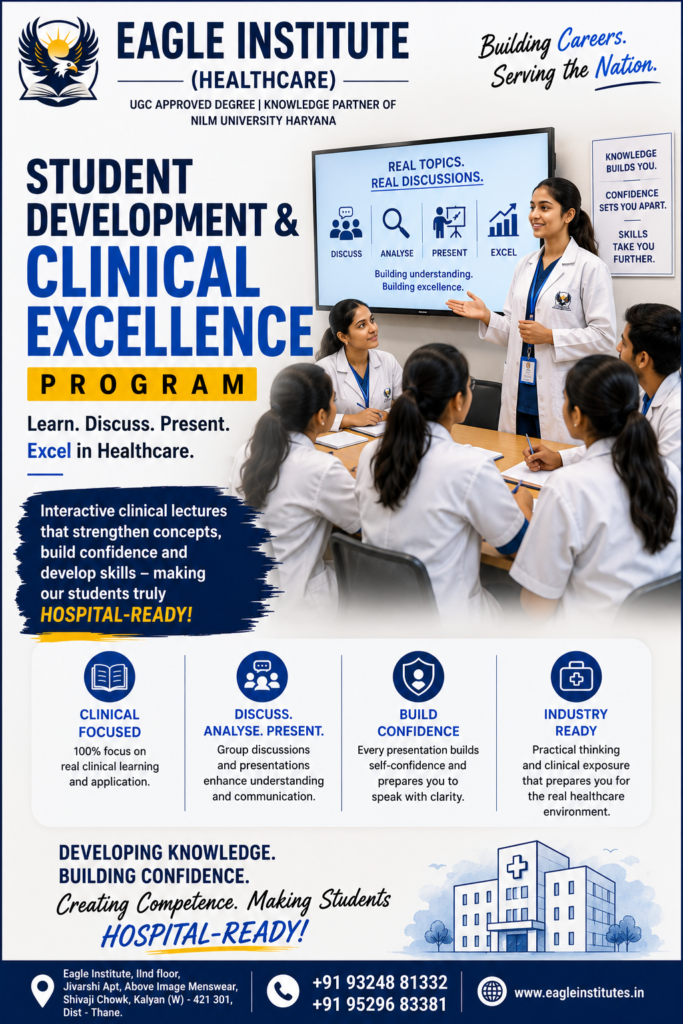
At Eagle Institute, we decided that gap shouldn’t exist. That’s why we launched the Student Development & Clinical Excellence Program (SDCEP), a dedicated weekly initiative designed and conducted by Ms. Jaanvi Tolani for our first-year paramedical and allied health sciences students across MLT, Operation Theatre, Radiology, Optometry, and Cardiac Care.
What Students Actually Learn
The program is built around real hospital scenarios, not abstract theory:
• Hospital Code Awareness — understanding Code Blue, Red, Pink, Yellow, Orange, Black, and White through role play, so an emergency announcement is never a mystery
• Basic CPR and First Aid Workshops (certified) — hands-on training in adult and child CPR, AED use, choking response, burns, fractures, bleeding, and road traffic accident management
• Hand Hygiene & Infection Control — WHO’s 7-step technique, PPE donning and doffing, and biomedical waste segregation
• Clinical Instrument Identification — hands-on familiarity with pulse oximeters, ECG machines, nebulizers, BP apparatus, defibrillators, and catheters
• Hospital Documentation — learning to actually fill a case sheet, consent form, admission form, OT checklist, and referral form
• Communication Skills (certified) — practicing doctor–patient conversations, breaking bad news, and telephone etiquette
• Professional Grooming & Soft Skills — lab coat etiquette, time management, resume writing, and mock interviews
Alongside these, students take part in group discussions, clinical case discussions, medical quizzes, debates, poster-making competitions, mini research projects, and final clinical skills demonstrations — building not just knowledge, but confidence, teamwork, and the ability to think on their feet.
The Certificate Advantage
Four sessions — Basic CPR, Basic First Aid, Research Awareness, and Communication Skills — carry a Certificate of Participation. These aren’t just add-ons for a resume; they represent verified, hands-on competence in life-saving and professional skills that hospitals actively look for when evaluating trainee readiness.
Why This Matters: No Student Walks in Blank
The real goal of SDCEP is simple: when our students walk into a hospital for their first clinical posting, they should not be starting from zero.
They’ll already know how to respond when a code is called. They’ll know how to properly don and doff PPE before entering a ward. They’ll recognize the instruments on a trolley instead of encountering them for the first time. They’ll know how to talk to a frightened patient, or a grieving family member, with composure instead of panic. They’ll understand hospital paperwork, professional conduct, and basic patient-care ethics — not as rules they’re told to follow, but as habits they’ve already practiced.
That is the real meaning of being “hospital-ready” — not just technical skill, but the presence of mind, discipline, and ethical grounding that lets a young trainee walk onto a ward and belong there from day one.
Looking Ahead
As SDCEP progresses through its 22 sessions, our students will move from role-play and workshops to real demonstrations — vision testing, blood collection, microscopy, ECG recording, and X-ray positioning — culminating in a final clinical skills demonstration in December.
At Eagle Institute, we believe that producing excellent healthcare professionals isn’t only about strong academics. It’s about building students who are clinically skilled, ethically grounded, and genuinely ready for the realities of patient care — from their very first day in the hospital
Why We Started SDCEP
Clinical competence isn’t just about knowing your subject — it’s about knowing how to function inside a hospital. A brilliant student who freezes when a Code Blue is announced, or who doesn’t know how to fill an admission form, is still unprepared for real patient care. SDCEP exists to close exactly that distance between academic learning and clinical reality.
Running every Thursday from August through December 2026, across 22 structured sessions, the program takes students well beyond the syllabus — into the actual rhythm, ethics, and expectations of hospital life.