Introduction
The healthcare industry is not limited to doctors and nurses. Behind every successful hospital, diagnostic centre, emergency department and healthcare facility, there is a large team of trained healthcare professionals who support diagnosis, treatment, patient care and hospital operations.
This is where paramedical and allied healthcare professionals play an important role.
For students who want to enter the healthcare sector and develop practical, career-oriented skills, paramedical education can provide a wide range of opportunities. Today, students can choose from specialised programs based on their interests—from emergency care and medical support to diagnostic services, rehabilitation and hospital-related roles.
At Eagle Institute (Healthcare), students can explore a diverse range of paramedical courses designed around different areas of healthcare.
Why Are Paramedical Courses Important?
Modern healthcare depends on much more than doctors alone. Healthcare professionals work as a team, and trained technical and support staff are essential to the functioning of hospitals and healthcare facilities.
Paramedical education helps students develop knowledge and practical skills related to specific healthcare functions. Depending on the chosen course, students may learn about patient support, emergency response, diagnostic procedures, hospital records, nutrition, surgical assistance, rehabilitation and other healthcare-related responsibilities.
These courses can therefore be an option for students who want to build a career in the medical and healthcare sector through a specialised skill-based pathway.
A Wide Range of Courses to Choose From
One of the biggest advantages of paramedical education is the variety of specialisations available. Students can choose a course according to their interests, educational background and career goals.
- First Aid
First Aid focuses on basic emergency assistance and immediate care during injuries or medical emergencies. Knowledge of first aid is valuable in healthcare settings and other situations where timely assistance can be important.
- Medical Dresser
Medical Dresser training focuses on assisting with wound care, dressings and related patient-care procedures under appropriate supervision.
- EMT – Emergency Medical Technician
Emergency Medical Technician training introduces students to emergency response and pre-hospital care. EMTs can form an important part of emergency healthcare teams.
- Community Health
Community Health focuses on healthcare awareness, preventive care and supporting health-related activities within communities.
- Acupuncture
Acupuncture is a specialised area of healthcare involving traditional therapeutic techniques. Students interested in complementary approaches to healthcare can explore this field.
- Audio & Speech Therapy Technician
This area introduces students to supporting professionals involved in communication, speech and hearing-related care.
- BCG Technician & Tuberculosis Program Management
This course focuses on areas related to tuberculosis programs and BCG vaccination support, providing exposure to an important aspect of public health.
- Blood Transfusion Technician
Blood transfusion services require trained personnel to support processes involving blood and blood components. This is an important specialised area within healthcare services.
- Burn and Plastic Surgery Technician
This specialised field relates to assisting healthcare teams involved in burn care and plastic surgery procedures.
- CT Scan Technician
CT imaging is an important diagnostic tool used in modern healthcare. Training in this area introduces students to the technical aspects of CT imaging and working within diagnostic environments.
- Clinical and Therapeutic Nutrition
Nutrition plays an important role in patient care and recovery. This field introduces students to clinical and therapeutic aspects of nutrition.
- Dental Hygienist Technician
Dental healthcare requires trained professionals who assist with oral hygiene and related dental-care services.
- Emergency & Trauma Care Technician
Emergency and trauma care requires quick, organised and skilled support. This course introduces students to the healthcare environment surrounding emergency and trauma cases.
- Hospital and Domiciliary Care Assistant
This area focuses on patient support and care within hospital and domiciliary settings.
- Hospital Record Keeping
Accurate records are an essential part of healthcare administration. This course introduces students to maintaining and managing hospital records.
- Interventional Radiology
Interventional radiology combines imaging with minimally invasive medical procedures. Students interested in advanced diagnostic and procedural healthcare environments can explore this specialised area.
- Medical Transcription & Typing
Healthcare generates a significant amount of clinical documentation. Medical transcription and typing focuses on the accurate handling and preparation of medical information.
- Minimal Access Surgical Technician
Modern surgery increasingly uses minimally invasive techniques. This specialised course introduces students to the environment and technical support associated with minimal access surgical procedures.
- Neonatal Care Technician
Newborn babies require specialised care, particularly in hospital and neonatal settings. This field focuses on supporting healthcare teams involved in neonatal care.
- Occupational Therapy
Occupational therapy focuses on helping individuals improve their ability to perform daily activities and participate in meaningful occupations following illness, injury or disability.
- Ophthalmic Assistant
Eye care is another specialised area of healthcare. Ophthalmic assistants support eye-care professionals and contribute to the functioning of ophthalmic services.
- Orthopaedic and Plaster Technician
This field focuses on supporting orthopaedic care, including procedures associated with plaster and immobilisation under professional supervision.
- Orthotic & Prosthetic Technician
Orthotic and prosthetic services help patients who require supportive devices or artificial limbs. This is a specialised technical area within rehabilitation healthcare.
- Respiratory Technician
Respiratory healthcare focuses on patients with breathing and respiratory-related conditions. Respiratory technicians can support healthcare teams in respiratory-care environments.
- Sanitation
Sanitation is an important component of safe healthcare environments. Proper sanitation and hygiene practices contribute to infection-control and patient safety.
- Ultrasonography Technician
Ultrasonography is widely used as a diagnostic imaging technique. Training in this area introduces students to the technical environment associated with ultrasound services.
⸻
Courses for Students from Different Educational Backgrounds
A common misconception is that a career in healthcare is only possible for students who have studied Science.
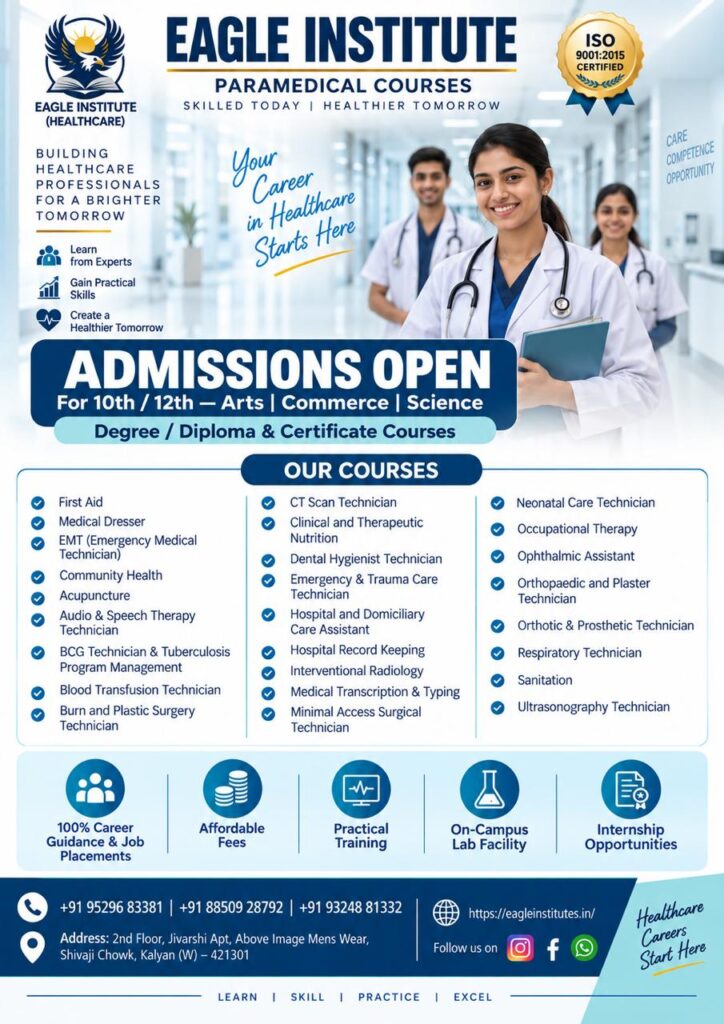
However, the eligibility and admission requirements can differ from one course to another. At Eagle Institute, the available course range includes options for students from Arts, Commerce and Science backgrounds, subject to the eligibility requirements of the particular program.
This makes it important for students to explore their options instead of assuming that a particular educational stream automatically closes the door to healthcare.
Whether a student is interested in emergency care, diagnostics, patient support, hospital services, rehabilitation or specialised healthcare technology, there may be a suitable pathway to explore.
Degree, Diploma and Certificate Options
Another advantage of choosing the right paramedical program is the availability of different course durations and formats.
Depending on the program, students can explore Degree, Diploma and Certificate courses. This allows students to consider an educational pathway according to their academic background, interests, career plans and the amount of time they want to invest in their education.
Before choosing a course, students should carefully check the eligibility criteria, duration, curriculum and career pathway associated with that particular program.
Practical Learning Matters in Healthcare
Healthcare is a practical field. Understanding concepts from textbooks is important, but students also need opportunities to develop practical skills and understand professional healthcare environments.
At Eagle Institute, the emphasis is on developing students through practical training, laboratory exposure, internship opportunities and career guidance.
The objective is to help students develop the knowledge, confidence and practical understanding required to move towards professional healthcare environments.
A Career-Oriented Alternative to the Traditional Medical Pathway
For many students, becoming a doctor through the traditional medical route is not the only way to build a career in healthcare.
Paramedical and allied healthcare education offers specialised pathways into different areas of the healthcare ecosystem. Students can choose a field based on their interests rather than looking only at one conventional career option.
For students who are looking for healthcare courses after 10th or 12th, paramedical education can therefore be an avenue worth exploring.
Importantly, students should choose courses based on their eligibility, interests, recognised program details and long-term career objectives rather than simply choosing a course because it is popular.
Why Choose Eagle Institute (Healthcare)?
Eagle Institute offers a wide range of healthcare and paramedical programs, giving students the opportunity to explore different areas of the healthcare sector.
The institute focuses on:
- Wide range of paramedical courses
- Degree, Diploma & Certificate options
- Practical training
- On-campus lab facility
- Internship opportunities
- Career guidance & placement support
- Options for eligible students from Arts, Commerce and Science backgrounds
Start Exploring Your Healthcare Career
A career in healthcare can take many different forms. You don’t necessarily have to follow just one path.
From Emergency Medical Technician and CT Scan Technician to Blood Transfusion Technician, Occupational Therapy, Respiratory Technician and Ultrasonography Technician, there are numerous specialised areas for students to explore.
The right course depends on your educational background, eligibility, interests and career goals.
Explore the courses at Eagle Institute (Healthcare) and find the healthcare pathway that is right for you.
📞 +91 95296 83381 | +91 88509 28792 | +91 93248 81332
📍 2nd Floor, Jivarshi Apt, Above Image Mens Wear, Shivaji Chowk, Kalyan (W) – 421301
🌐 eagleinstitutes.in